
Foreign investors pulled out Rs 4,285 crore from Indian equities in the first three trading days of the month driven by apprehensions ahead of the third-quarter earnings season and high valuations of domestic stocks. This came following an investment of Rs 15,446 crore in the entire December, data with the depositories showed.

From the Sensex firms, Adani Ports, Bajaj Finance, Tech Mahindra, IndusInd Bank, Nestle and Tata Steel were among the major laggards. In contrast, Mahindra & Mahindra, Titan, Larsen & Toubro, Bharti Airtel and Maruti were among the gainers.

The Reserve Bank of India's (RBI) Monetary Policy Committee's (MPC) decision to cut the repo rate by 50 basis points (bps) to 5.5% was contrary to the expectations of many economists. Firstly, most of the economists expected the MPC to cut the repo rate by 25 bps citing the weakening of inflation, prospects of economic growth, geopolitical uncertainty and comfortable system liquidity.

'He has been one of the clearest thinkers in the history of business.'

Foreign portfolio investors (FPIs) pulled out as much as Rs 17,537 crore from the Indian markets in just three trading sessions of March as investors' sentiment got dented by the uncertainty triggered by the Russia-Ukraine conflict and rising crude oil prices. As per depositories data, they pulled out Rs 14,721 crore from equities, Rs 2,808 crore from debt segment and Rs 9 crore from hybrid instruments between March 2-4. This took the total net outflow to Rs 17,537 crore.

On the eve of the Budget, top foreign brokerage houses Morgan Stanley and JP Morgan were advising investors to stay away from the Indian stock markets, saying the risk factors involved in Indian equities are much higher.

'Somebody was using somebody to make statements that will stir the stock market and lead to a surge.' 'A sudden surge and a sudden crash is always an ideal situation for people to make illicit gains and then siphoning off the money.'
Market experts see interest in Indian equities given the strong economic growth, robust earnings and rising domestic consumption.

Donald Trump's tariffs, meant as political punishment, have avoided the predicted chaos, lifting US growth, weakening rivals, and letting him claim victory in a resilient global economy, observes T T Ram Mohan.

In the past 10 years, over 500 PSB officers have died by suicide. When targets are overwhelming, senior management and customers are both impatient, and there is constant fear, not every banker has the resilience to survive and thrive, warns Tamal Bandyopadhyay.

'The reported deal between the European Union and China should mitigate it (shortage) for the medium to long term. Let's wait and watch how this plays out.'

A host of macroeconomic data announcements, the last batch of September quarter earnings, global trends, and trading activity of foreign investors will be the major driving factors for the equity market this week, according to analysts. Equity markets would remain closed on Friday for Guru Nanak Jayanti. "India is set to release CPI and IIP data on November 12, with WPI data expected on November 14.

Electric cab-hailing platform BluSmart remained non-operational on Thursday across Delhi-NCR, Bengaluru, and Mumbai, as the market regulator cracked down on its co-founder over alleged misuse of funds at an affiliated company. BluSmart app, that offered more than 8,000 taxis in the three metros, stopped taking bookings on Wednesday evening and remained unoperational on Thursday as well.

State Bank of India (SBI), the largest lender in the country, has launched a share sale to institutional investors to raise upto Rs 25,000 crore, the biggest qualified institutional placement (QIP) so far by an Indian firm, and has set a floor price of Rs 811.05, which is at a 2.5 per cent discount on Wednesday's closing price.
Bear Stearns, which was registered as a foreign institutional investor in 2004, sold an additional 40.2 million shares valued at Rs 677 crore on the National Stock Exchange on Monday, taking its total sales to Rs 943 crore in the last two days.

India needs to be technologically and militarily prepared to defend itself from both Pakistan and China, alerts Ramesh Menon.

'Even if India is attractive, FPIs currently lack the funds to invest, as money is being redirected to the US.'

'India's fundamentals are a lot better (than those of other emerging market economies).' 'India will suffer (witness a fall in its stock market) what I call the second order effect.' 'And the second order will happen when these funds (belonging to macro and hedge fund investors and which have leveraged Japanese yen-carry trades), because they lose money elsewhere as lot of their positions were financed by borrowing Japanese yen, will have to book profits in investment destinations where they are making money, including in markets like India.' 'They (these investors) will have to effectively sell in countries like India and which is the consequence (the crash in equity markets) that Indian markets might see.'

'The long-term impact of elections is minimal.'

Sebi has asked stock exchanges and other market participants to remain watchful of funds and entities with Iranian links, as the global inter-governmental agency FATF continues to classify Iran as one of the 'high-risk and non-cooperative jurisdictions' with respect to money laundering and terror financing activities.

'Youngsters in India look up to the West as if it is the biggest accomplishment they need in life. It breaks my heart.'
FII holding in top listed firms at 10-year high as retail investors, domestic institutions & funds scale down presence.

Equity benchmark Sensex on Thursday plunged about 965 points to crash below the 80,000 level due to heavy selling in global equities after the US Federal Reserve signalled fewer rate cuts next year. Besides, deep losses in consumer durables, banking and IT stocks amid foreign fund outflows added to the gloom, analysts said.

Trump's tariffs, falling shrimp prices, and fears of additional US levies, spark a crisis in Andhra Pradesh's politically vital aquaculture sector.

The ministry on Sunday decided to allow foreign individuals and pension funds, as well as other entities, to invest directly in equity markets.

From the 30-share Sensex firms, Tata Motors, Bajaj Finance, Eternal, Adani Ports, Tata Steel, Titan, Mahindra & Mahindra and Power Grid were among the gainers. Asian Paints, Sun Pharma, ITC, Nestle, Reliance Industries and HCL Tech were among the laggards.

'Expect FPIs to continue selling for several months until the rupee stabilises.'

The Securities and Exchange Board of India (Sebi) has approved a proposal from a startup to test fractional shares in its innovation sandbox, marking a potential shift in the Indian equity landscape. This represents a change in stance from 2021, when Sebi rejected a similar proposal in the regulatory sandbox, primarily due to concerns over the custody of fractional shares.

The crisis may not be as visible this time, but the stakes are just as high, points out Rajeswari Sengupta.

Equity benchmark indices Sensex and Nifty settled lower for the sixth straight session on Monday due to heavy selling in bellwether stocks including HDFC Bank and Reliance Industries amid mixed trends in the global markets and outflow of foreign funds. Falling for the sixth consecutive session, the BSE Sensex tumbled 638.45 points or 0.78 per cent to settle at 81,050. During the day, it plummeted 962.39 points or 1.17 per cent to 80,726.06. The NSE Nifty slumped 218.85 points or 0.87 per cent to end at 24,795.75.

Passive funds tracking the National Stock Exchange Nifty Next 50 Index have seen their assets under management (AUM) more than double in the past year. The index's growing popularity can be attributed to its robust 50 per cent return over the same period. Currently, the AUM of funds tracking the Nifty Next 50 index stands at nearly Rs 30,000 crore.
A piece of slightly negative news can cause a serious setback, warns Debashis Basu.

Analysts are warning of growing risks to the market's sustained momentum, and even to the possibility of consolidation at current levels. Domestically, markets are grappling with several challenges, including a slowing economy, as indicated by the latest GDP data for the July-September (Q2) quarter of 2024-25 (FY25), sticky inflation, fluctuations in the rupee, waning consumption, and high interest rates.

The market could be influenced by events elsewhere in the world and regardless of what happens to India's economy
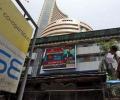
Shares of Tata Group companies on Thursday rose up to 10 per cent, with Tata Chemicals and Tata Teleservices among the major gainers. Tata Sons Chairman Emeritus Ratan Tata, who played a key role in transforming the group into a global conglomerate, passed away late on Wednesday. He was 86. "Investors can pay tribute to Ratan Tata and the great corporate empire he built by buying stocks like TCS, Tata Motors, Tata Steel, Tata Consumer and Indian Hotels.
Indian stock markets have developed a resilience to political hurdles, reforms and have aligned to global cues which decide the direction of their movement, a report by a leading investment bank has said.

The Indian equity markets have significantly increased in importance within the emerging market (EM) basket of stocks in recent years. Since 2018, India's weighting in the Morgan Stanley Capital International (MSCI) EM Index - tracked by passive funds with assets of nearly $500 billion - has doubled, while the number of domestic stocks has grown by almost 70 per cent.

Richest Indian Gautam Adani and mining baron Anil Agarwal on Sunday led India Inc in paying tributes to veteran stock market investor Rakesh Jhunjhunwala, who passed away early Sunday morning. "Extremely saddened by the untimely passing away of the most legendary investor that India has had. "Shri Jhunjhunwala inspired an entire generation to believe in our equity markets with his brilliant views.
 © 2026 Rediff.com - Advertise with us - Disclaimer - Privacy Policy - Sitemap - Feedback - About us - Terms of use - Grievances